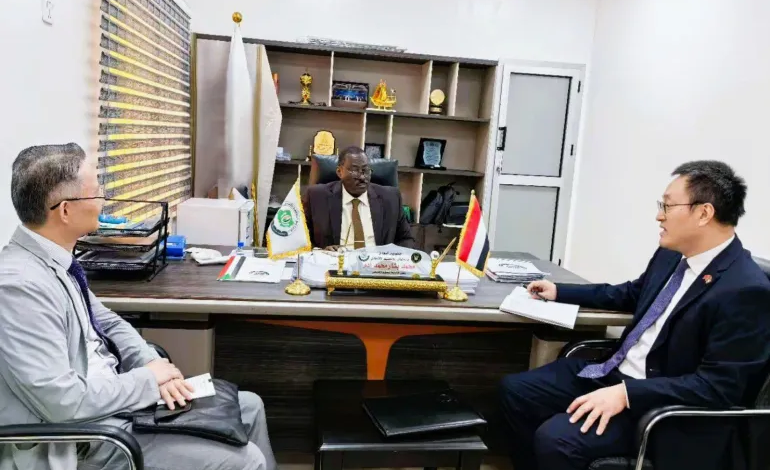
China plans to exempt Sudan from repaying debts worth 345 million yuan (about $45 million), representing interest-free loans previously provided by Beijing to finance various projects in Sudan, according to a statement by Sudan’s Ministry of Finance and Economic Planning.
The announcement followed a meeting held on Wednesday between Mohamed Bashar, Undersecretary for Planning at the Ministry of Finance and Economic Planning, and Shu Jian, the Chargé d’Affaires of the Chinese Embassy in Sudan. The meeting also discussed the status of implementation of a previously approved Chinese grant worth 200 million yuan (approximately $28.58 million), allocated to support infrastructure projects in Sudan, particularly in the water, agriculture, and electricity sectors.
For his part, the Chinese chargé d’affaires affirmed his government’s readiness to provide an additional grant through United Nations agencies to support the implementation of solar energy projects for drinking water stations in the targeted states of Khartoum, Al-Jazira, Sennar, and Blue Nile.
Sudan’s Debt Situation
According to a World Bank report, Sudan’s public debt reached 147% of GDP in 2024, and is expected to decline to 142% in 2025, 124% in 2026, and 106% in 2027.
The report noted that after October 2021, Sudan had been making progress toward debt relief and regaining access to international financing under the Heavily Indebted Poor Countries (HIPC) Initiative, launched by the International Monetary Fund and the World Bank in 1996. However, this progress stalled due to political instability and the outbreak of war between the Sudanese army and the Rapid Support Forces.
Currently, the Sudanese government is unable to issue new public debt securities, leaving monetary financing as the only available option to cover the budget deficit. Public debt is therefore expected to remain high, with expenditures rising to 9.9% of GDP, despite a projected increase in revenues to 6.2% of GDP by 2026, due to ongoing fiscal challenges and the absence of debt relief under the HIPC Initiative.