Israeli Shelling Continues East of Deir al-Balah and Khan Younis as Health Authorities Warn of Meningitis Spread in Gaza

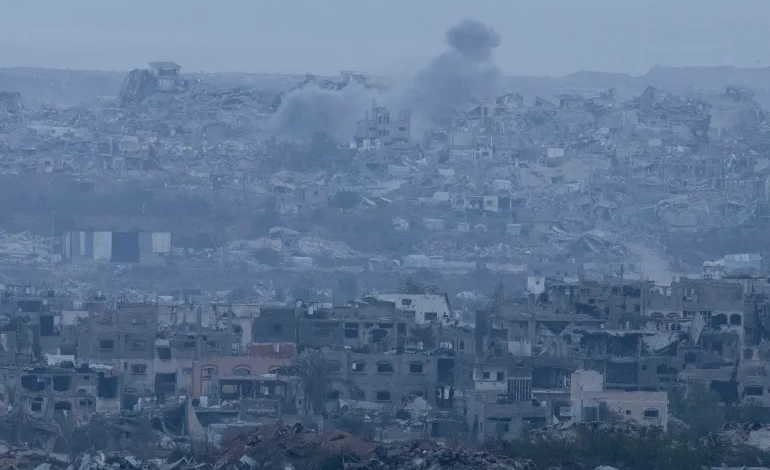
Al Jazeera’s correspondent reported that Israeli warplanes and artillery targeted areas of Israeli military deployment east of Deir al-Balah in central Gaza and Khan Younis in the south, in a renewed military escalation, as Gaza’s Ministry of Health announced the death of a child due to meningitis.
The correspondent said that intense Israeli artillery shelling and heavy tank fire have been ongoing since dawn on Wednesday, targeting areas east of Khan Younis. He added that Israeli fighter jets carried out three airstrikes on evacuated houses within areas still under Israeli military control east of Deir al-Balah.
In northern Gaza, local sources and eyewitnesses reported at least two powerful explosions resulting from Israeli demolition operations in areas still occupied by Israeli forces east of Jabalia refugee camp.
Israeli artillery also shelled the eastern neighborhoods of Gaza City, while military vehicles stationed east of the city opened heavy machine-gun fire toward residential areas.
Since the agreement came into effect, continued Israeli violations have resulted in the killing of 486 Palestinians and the injury of 1,341 others. The agreement ended a genocidal war launched by Israel on October 7, 2023, which lasted nearly two years and left more than 71,000 Palestinians killed, 171,000 wounded, and massive destruction affecting around 90% of civilian infrastructure. The United Nations has estimated reconstruction costs at approximately $70 billion.
Meningitis
On the humanitarian front, Dr. Ahmed Al-Farra, director of the Pediatric Hospital at Nasser Medical Complex in Khan Younis, said that six cases of meningitis were recorded over the past two days, leading to the death of a child, Eileen Asfour, after her condition rapidly deteriorated.
Dr. Al-Farra warned of the serious risk of the disease spreading in displacement camps, citing severe overcrowding and extremely poor health and sanitation conditions among displaced families.
Meanwhile, Dr. Mohammed Abu Salmiya, director of Al-Shifa Medical Complex in Gaza, said the health situation in the Strip has reached its worst level since the start of the genocidal war, warning that more than 70% of essential medicines — including life-saving drugs — have run out due to the tightened blockade and the continued ban on the entry of medical supplies.
In statements to Al Jazeera, Abu Salmiya said hospitals are operating with the bare minimum of resources, while the number of patients continues to rise amid the spread of epidemics and seasonal viruses that have claimed the lives of children and elderly people in recent days.
He added that medical staff continue to work despite being directly targeted, noting that around 1,600 healthcare workers have been killed and hundreds detained. He stressed that their resilience stems from their humanitarian duty toward their people.
Abu Salmiya called for urgent international pressure to allow the entry of medicines and medical equipment, warning that more lives will be lost that could have been saved if border crossings were opened after more than two years of continuous war on Gaza.
Currently, Gaza’s health sector is functioning at minimal capacity through only 16 hospitals under extremely harsh conditions, after 22 hospitals were completely put out of service due to Israeli destruction. In addition, 103 primary healthcare centers have been destroyed, depriving hundreds of thousands of people of basic medical care.
The ambulance system has also suffered extensive damage, with 211 ambulances targeted and 25 oxygen generation stations destroyed out of 35. At the same time, 90% of blood bank and transfusion supplies have been depleted to zero, posing a grave threat to the lives of wounded patients and those in intensive care and emergency units.