The camera of the program “Ma’a Al-Hakim” on Al Jazeera Mubasher opened a window into the world of modern sports medicine, where serious injuries are no longer the end of an athlete’s journey, but rather a challenge that can be overcome through science, technology, and determination.
Broadcasting from the specialized “Icon” Medical Center in Qatar, dedicated to orthopedic and sports injury treatment, viewers followed two real-life stories of athletes whose careers were nearly cut short—until advanced medical techniques helped them return to competition.


The first story featured footballer Ahmed Manasrah, who suffered a severe knee injury during a match, resulting in a complete anterior cruciate ligament (ACL) tear and meniscus damage.
Ahmed described how a sudden twist of the knee dramatically altered his athletic path. Persistent pain and instability prevented him from jumping or training properly, with the injury recurring repeatedly despite attempts to return.
After several unsuccessful efforts, he sought treatment at Icon Medical Center, where he met Dr. Mohammed Rehayawi, an orthopedic consultant and German board-certified specialist in sports medicine.
Comprehensive examinations and MRI scans confirmed the severity of the injury. Surgery was recommended using an advanced German technique known as “TightRope,” which reconstructs the ACL without relying on traditional fixation screws.
Despite initial fears, Ahmed proceeded with the minimally invasive arthroscopic procedure. Within days, he was discharged home, and after just one week began an intensive physiotherapy program at the center.
Contrary to expectations, Ahmed required only seven to eight weeks to fully regain his athletic activity, returning to the gym without pain or complications.
Medical Insight into the Case
Speaking in the studio, Dr. Rehayawi explained that Ahmed’s injury was a severe one that directly affects knee stability and athletic performance. He noted that complete ACL tears in athletes rarely respond to conservative treatment.
He emphasized that the goal of surgery was not merely pain relief, but restoring full joint stability and protecting the knee from cartilage degeneration and future injuries.
Dr. Rehayawi highlighted the advantages of the TightRope technique, including greater precision in graft fixation, less invasive intervention, reduced postoperative pain, and faster recovery compared to traditional screw-based methods.
He stressed that surgical success depends heavily on adherence to physiotherapy, noting that recovery rates can reach up to 95% when rehabilitation protocols are properly followed.
A Second Comeback: Shoulder Surgery Revives a Weightlifting Career
The second story focused on weightlifting champion Abdel Salam Halawa, who sustained a right shoulder injury involving a torn biceps tendon after years of competing in strength sports.
Having transitioned between bodybuilding, powerlifting, and Olympic weightlifting, Abdel Salam found himself facing both physical and psychological challenges, fearing he might never return to competition.
After multiple consultations, he arrived at Icon Medical Center under the care of Dr. Ibrahim Ibrahim, an orthopedic and sports injury consultant certified in European arthroscopic surgery.
Diagnostic imaging revealed a superior labral tear in the shoulder joint, a severe biceps tendon rupture, as well as inflammation and impingement—injuries commonly seen in weightlifting due to heavy repetitive stress on the joint.
A decision was made to perform advanced arthroscopic surgery to repair the damaged cartilage, stabilize the biceps tendon, and clean inflammatory tissue within the joint.
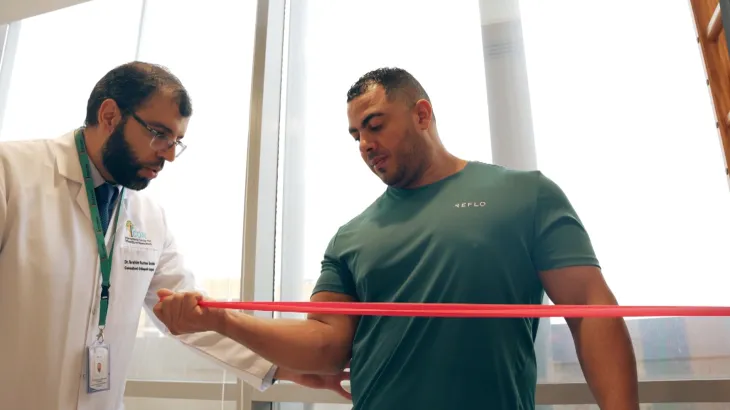
Following surgery, Abdel Salam embarked on a comprehensive recovery journey that included both physical rehabilitation and psychological support under close medical supervision.
Within weeks, he gradually regained full range of motion and strength, returning to competition and achieving top rankings. He posted impressive results in the clean and jerk and snatch events, expressing ambitions to set even higher records in the future.
Dr. Ibrahim explained that the shoulder joint is particularly vulnerable due to its wide range of motion, which makes it inherently less stable and highly dependent on surrounding muscles and tendons.
He warned that improper movement or repetitive strain—especially in weightlifting and racket sports—can lead to serious injuries if not addressed early.
He also underscored the central role of physiotherapy, noting that surgery is only the first phase of recovery, while physical and psychological rehabilitation ultimately ensures a safe and confident return to peak performance.