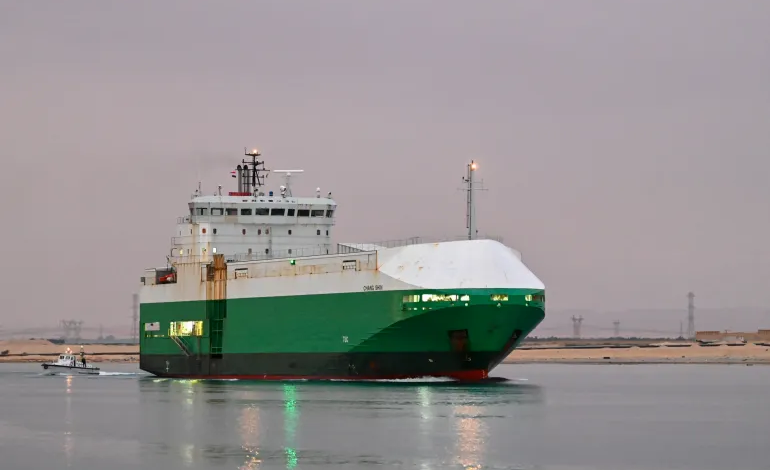
Major global shipping companies are preparing for a potential decline in profits in 2026, as expectations grow that the Red Sea shipping corridor could fully reopen. Such a development would likely push freight rates lower and intensify the structural oversupply already weighing on the global maritime transport market.
A return to normal traffic through the Red Sea would significantly shorten transit times between Asia and Europe. During the Israel–Gaza war, shipping lines were forced to reroute vessels around the Cape of Good Hope to avoid attacks in the strategic waterway, resulting in longer voyages and higher transportation costs that temporarily supported freight rates.


According to Bloomberg, several major carriers—including Denmark’s A.P. Moller-Maersk, Germany’s Hapag-Lloyd, Japan’s Nippon Yusen, and China-linked firms Orient Overseas International and COSCO Shipping—are expected to report weaker earnings in 2026. This follows a year already marked by tariff disruptions linked to U.S.-led trade tensions.
Analysts at Bank of America warn that the resumption of Red Sea shipping could worsen what they describe as a “structural overcapacity” problem. Fleet expansion continues at a record pace, with Bloomberg Intelligence estimating that global vessel capacity will increase by 36% between 2023 and 2027.
Demand for container shipping is also projected to decline by 1.1% in 2026, assuming a full return of container ships to Red Sea routes. Shorter voyages reduce the need for additional vessels, further amplifying supply pressures.
Meanwhile, the World Container Index published by Drewry shows global freight rates falling 4.7% to $2,107 per 40-foot container in the week ending January 29, signaling early signs of easing price momentum.
Although a full-scale return to Red Sea operations is not guaranteed, the possibility has strengthened after Maersk successfully completed two transits through the corridor—the first since attacks escalated in 2023.
Potential Price Pressures and Short-Term Market Dynamics
Analysts at HSBC had previously estimated that if Red Sea disruptions persisted until at least mid-2026, freight rates could fall between 9% and 16% this year. With Maersk’s renewed crossings, the bank now anticipates an additional 10% decline, potentially impacting the profitability of both Maersk and Hapag-Lloyd.
However, some analysts suggest that short-term factors could temporarily support rates. A rapid resumption of traffic may cause congestion at European ports, while experts at Citigroup note that Western economies may seek to rebuild inventories in the first half of 2026, providing a temporary boost to shipping demand.
For now, major carriers are proceeding cautiously. They remain hesitant to implement sweeping network adjustments, wary that any sudden escalation could once again force rerouting. Cargo owners, particularly those shipping high-value goods, remain concerned about security risks. At the same time, ports may struggle to accommodate a sudden influx of vessels if traffic returns quickly.
As a result, 2026 is shaping up to be a challenging year for the global shipping industry—marked by expanding capacity, downward price pressures, and ongoing geopolitical uncertainty that could once again reshape global trade routes.