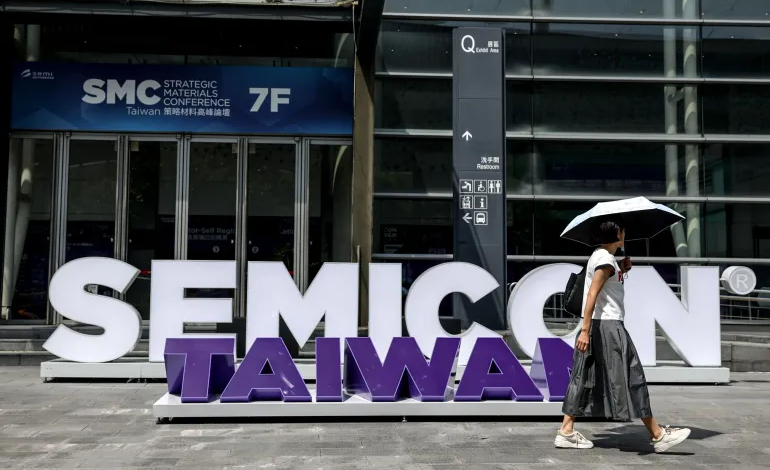
The US Department of Commerce announced the conclusion of a trade agreement with Taiwan that reduces tariffs and significantly strengthens investment in the semiconductor sector within the United States, as part of broader American efforts to reshore sensitive industries and reduce external dependence.
According to Agence France-Presse, the agreement stipulates a reduction in tariffs previously imposed under former President Donald Trump from 20% to 15%, aligning them with the tariff levels applied to Japanese and European products.

In return, Taiwanese semiconductor companies have committed to investing no less than $250 billion in the United States to expand production capacity and deepen their industrial footprint in the American market.
The agreement also includes an additional $250 billion in investments aimed at reinforcing the US semiconductor manufacturing ecosystem, covering supply chains, materials, equipment, and supporting production stages. This move seeks to strengthen the domestic industrial base of this strategic sector.
In a separate statement cited by Reuters, the US Department of Commerce said the agreement is intended to “largely reshore the semiconductor sector to the United States,” noting that reciprocal tariffs on Taiwanese imports will be capped at 15%.
Speaking to CNBC, US Commerce Secretary Howard Lutnick said Taiwanese companies would invest $250 billion, alongside comparable investments from the Taiwanese government, to expand semiconductor manufacturing in the United States. He described the move as a major step toward enhancing America’s economic and technological security.
According to AFP, the agreement follows months of negotiations during which Taiwanese President Lai Ching-te pledged to increase investments in the United States and raise defense spending, as part of Taipei’s efforts to reduce US tariffs and shield its semiconductor exports from potential negative impacts.
The US Department of Commerce also confirmed that Taiwanese companies building new chip production facilities in the United States will receive preferential treatment should any future tariffs be imposed on semiconductors, signaling a clearer link between trade policy and industrial investment decisions.
In Taipei, Taiwanese Prime Minister Cho Jung-tai welcomed the agreement, saying its outcome “confirms that the progress achieved came through arduous negotiations,” reflecting the sensitivity of the talks and the high economic stakes involved.