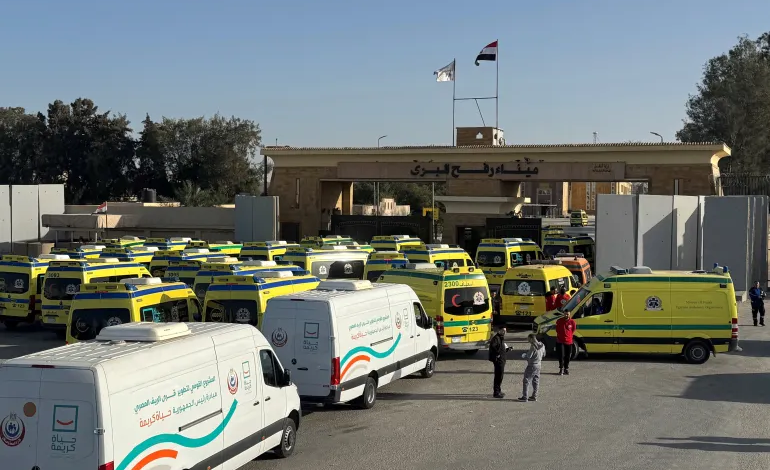
Movement of individuals through the Rafah border crossing between the Gaza Strip and Egypt resumed on Monday in both directions under tight restrictions and limited capacity, following an announcement by the Israeli army that it had completed the construction of a corridor to inspect and screen those entering the enclave.
This report highlights the key details surrounding the procedures governing the reopening of the crossing.
Who Is Allowed to Leave?
According to the Israeli Broadcasting Authority, entry and exit at this stage will be limited exclusively to Gaza residents, with an initial daily capacity of around 200 people. Estimates suggest that the number of those leaving Gaza will exceed those entering. Israel will grant prior approval for exit lists submitted from the Gaza Strip.
Under the current arrangement, approximately 150 Gazans will be allowed to leave the enclave each day. The European mission responsible for operating the crossing will submit a list of 150 individuals wishing to exit Gaza to the Egyptian authorities, including their final destinations. Egypt will retain the right to approve or reject these requests.
Who Is Allowed to Enter?
At the same time, Egyptian authorities will send a daily list of 50 Gazans seeking to enter the Gaza Strip. Following security screening, those approved will be allowed to enter the following day.
Individuals who left Gaza during the war will be permitted to return after coordination with Egypt and obtaining Israeli security approval. The European mission will carry out an initial screening of travelers, followed by additional procedures along the corridor under Israeli military control.
After prior approval, incoming travelers will be transported by bus to an Israeli inspection point, where security checks will include facial recognition and physical searches to ensure that no unauthorized equipment or materials are brought into the enclave.
Foreign journalists will not be allowed to enter Gaza at this stage.
Who Manages the Crossing?
The Israeli army announced that the corridor has been named “Regevim” and will be administered by Israeli security agencies. Security forces will verify the identities of travelers listed on the pre-approved rosters, while the crossing itself will be operated by Palestinian staff under European supervision.
The technocrats committee, known as the National Committee for the Administration of Gaza, is expected to enter the enclave through the Rafah crossing in the coming days. The Israeli army stated that the corridor is part of efforts to enhance security oversight in the area, while Israeli sources confirmed the committee’s imminent entry.
Key Criticisms
Israeli procedures have drawn sharp criticism, turning the hopes of more than 22,000 patients and wounded individuals seeking to leave Gaza for treatment into a complex bureaucratic and security ordeal.
A wide gap has emerged between the urgent medical needs in Gaza and the security restrictions imposed as part of the crossing’s operating mechanism. Israeli estimates cap the daily number of people allowed to leave Gaza at around 150, while Gaza’s Government Media Office Director Ismail Al-Thawabta stated that approximately 22,000 patients and wounded individuals urgently require treatment abroad and already possess complete medical referrals.
At this pace, enabling all patients and wounded individuals to leave Gaza would take around 147 days, or nearly five months.
Meanwhile, the reopening of the crossing has focused primarily on the movement of individuals, with little clarity regarding the entry of urgent humanitarian supplies. According to estimates, Gaza requires the daily entry of no fewer than 600 aid trucks.
Hamas spokesperson Hazem Qassem stated that any Israeli obstruction or conditions imposed on the Rafah crossing would constitute a violation of the ceasefire agreement, calling on mediators and guarantor countries to closely monitor Israel’s conduct at the crossing.