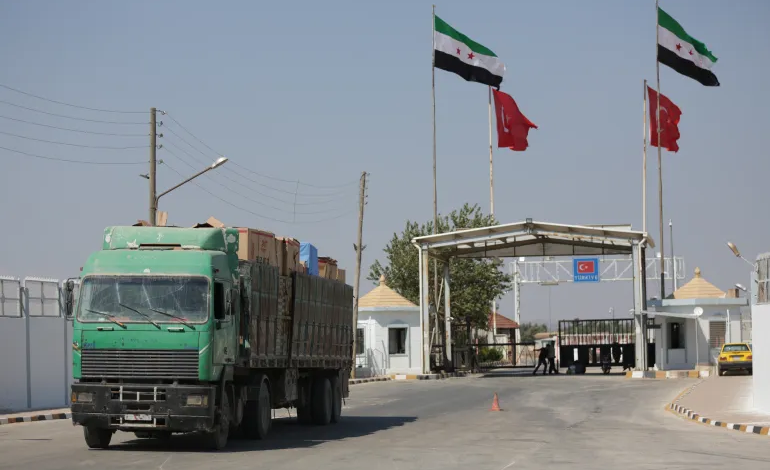
Turkish exports to Syria recorded a significant surge in 2025, rising by nearly 69% compared to the previous year, reflecting a noticeable improvement in bilateral trade following Syria’s political changes in late 2024.
According to data released by the Turkish Exporters Assembly, Turkey’s exports to Syria amounted to approximately $1.514 billion in 2024, before jumping by 69.6% in 2025 to reach $2.568 billion.

The data showed that the strongest growth was achieved in the cereals, pulses, oilseeds, and related processed products sector, which rose by 35.4% to a total value of $700 million.
The chemicals and chemical products sector ranked second, with exports reaching $299 million, followed by the electrical and electronics sector, which recorded exports worth $224 million.
The improved performance was attributed to a more favorable trade environment following the collapse of Bashar al-Assad’s regime in late 2024, a development that positively impacted the flow of goods and economic cooperation between Turkey and Syria.
A Methodical Effort
In remarks to Anadolu Agency, Jalal Qadoglu, Head of the Syria Trade Desk at the Turkish Exporters Union, said the surge in exports was not the result of isolated developments but rather the outcome of a systematic effort sustained throughout the year.
He explained that 2025 witnessed the rebuilding of Turkish-Syrian trade relations on more predictable, institutional, and sustainable foundations, noting that meeting exporters’ needs and maintaining continuous coordination with relevant authorities played a key role in achieving these results.
Qadoglu added that export figures confirm the Syrian market is no longer limited to border trade, but is increasingly attracting production centers from across Turkey. He also pointed out that improved stability in the Middle East has provided a stronger basis for long-term economic relations.
He further noted that reintegrating Syria into regional trade networks not only boosts bilateral exchange, but also opens broader commercial corridors extending to Middle Eastern, African, and Gulf markets.