Gaza Peace Council Discusses Disarmament Plan with Netanyahu as Israel Maintains Military Stance

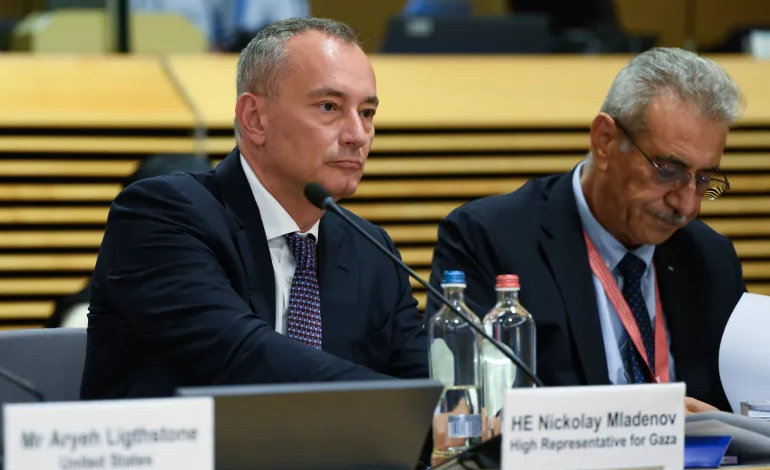
The Gaza Peace Council announced that it held talks today with Israeli Prime Minister Benjamin Netanyahu and his team regarding the implementation of a disarmament plan for the Gaza Strip and preparations for a transitional phase toward civilian governance.
According to the council, any Israeli withdrawal beyond the so-called “Yellow Line” would remain conditional on the complete disarmament of the Gaza Strip. It emphasized that full disarmament is a fundamental requirement for moving forward with the next phase of the proposed framework.


The council stated that the ultimate objective is to eliminate all armed structures in Gaza and transition from military control to a civilian governing system. The proposed plan covers both light and heavy weapons, as well as underground tunnel networks, as part of a comprehensive effort to dismantle the territory’s military infrastructure.
It added that the disarmament process would be supervised by an International Stabilization Force, while a dedicated monitoring committee would oversee compliance and verify the implementation of all agreed measures.
Earlier, a source within the Israeli Prime Minister’s Office said that the Israeli military would not withdraw from the “Yellow Line” inside Gaza and would continue its operations despite ongoing efforts to secure a ceasefire.
These developments follow Friday’s announcement by U.S. President Donald Trump and the Gaza Peace Council that an understanding had been reached on implementing the next phase of the Gaza ceasefire agreement.
The council also released a roadmap outlining the final stages of the proposed plan, including arrangements for disarmament, a gradual Israeli withdrawal from Palestinian territories, and the establishment of a verification mechanism involving mediators, the Gaza Peace Council, and the International Stabilization Force.
Israel Rejects International Force Proposal
Meanwhile, the Israeli Prime Minister’s Office informed the United States of its reservations regarding the roadmap, despite President Trump’s support for the initiative, stressing that the published version does not represent Israel’s official position.
Government spokesperson Doron Spielman stated that any permanent settlement in Gaza must be preceded by a complete, verifiable, and irreversible disarmament of Hamas.
He added that Israeli intelligence assessments indicate Hamas has rebuilt military capabilities and recruited new members since the ceasefire began, arguing that any arrangement falling short of total disarmament would leave Israel exposed to future security threats.
Israeli Channel 14 also reported that Finance Minister Bezalel Smotrich and Settlement Minister Orit Strook urged Netanyahu to block the deployment of the proposed International Stabilization Force in Gaza.
The ministers argued that the published roadmap differs from the version previously presented to the cabinet and warned that it could undermine Israel’s military objectives and conflict with efforts to fully disarm Hamas.
National Security Minister Itamar Ben-Gvir likewise rejected any international security presence in Gaza, insisting that only Israel is capable of defeating Hamas. He also called on Netanyahu to submit any Gaza agreement to the Knesset for approval instead of handling it confidentially.
In contrast, the Gaza Peace Council’s roadmap calls for an immediate and comprehensive halt to Israeli military operations, followed by a phased withdrawal of Israeli forces from the Gaza Strip—an approach that differs significantly from Israel’s publicly stated policy of maintaining its military presence until disarmament is completed.
Fighting Continues on the Ground
Former Fatah official Mohammed Dahlan said he had spoken with Jared Kushner, son-in-law of U.S. President Donald Trump, after the roadmap was announced. According to Dahlan, Kushner initially indicated that Israel would halt its airstrikes on Gaza starting Sunday.
However, Dahlan later revised his statement, saying only that Kushner had informed him he was working with the Israeli side to stop the attacks. Dahlan subsequently accused Prime Minister Netanyahu of obstructing what he described as the most significant opportunity yet to begin ending the war.
Despite ongoing diplomatic efforts, Israeli military operations continued across the Gaza Strip. According to Gaza health authorities, Israeli strikes since Saturday have killed 34 Palestinians, including women and children, and injured 134 others. The Health Ministry also reported that an Israeli strike targeted a warehouse containing medicines and medical supplies belonging to Al-Aqsa Martyrs Hospital in Deir al-Balah, central Gaza.