Iraq’s Archaeological Heritage Under Pressure as Investment Threatens Babylon, Samarra and Kufa

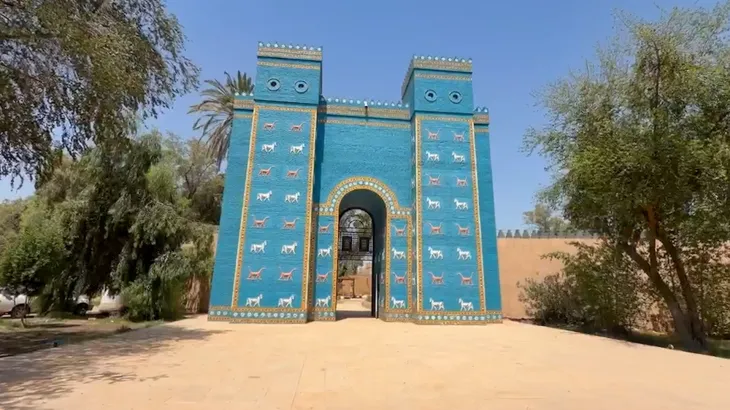
From the ancient city of Babylon, south of Baghdad and closely associated with some of the earliest legal traditions in human history, an investigation has examined the growing pressure on Iraq’s archaeological sites, amid the expansion of residential and investment projects into areas that are supposed to receive legal protection and, in some cases, international protection as World Heritage sites.
The investigation highlights the growing overlap between investment interests, land ownership and archaeological preservation, raising concerns that continued encroachment could result in the permanent loss of parts of Iraq’s irreplaceable cultural heritage.

Wheat Trucks Alongside Ancient Babylon
At the entrance to the archaeological city of Babylon, trucks loaded with wheat were seen lining the road beside the archaeological site during the wheat marketing season.
Local authorities say the diversion of the trucks to the road running alongside the ancient city is only a temporary measure intended to reduce traffic congestion in central Hilla until the agricultural marketing season ends.
But the trucks are only one part of a broader scene.
Tourist farms and residential buildings have appeared around Babylon’s ancient walls, with some structures built on land officially classified as agricultural.
Residents insist that their homes lie outside the archaeological walls. However, specialists warn that this does not necessarily eliminate the threat to the site, particularly because large parts of ancient Babylon have yet to be excavated.
Babylon’s Buried Archaeological Wealth
Experts estimate that archaeological excavations have so far uncovered only around 10% of the historic city, meaning that vast areas of ancient Babylon remain buried underground.
This makes the areas surrounding the known archaeological remains potentially significant, even where the land is currently being used for agricultural or residential purposes.
Some homeowners, meanwhile, say they purchased their properties through valid agricultural deeds because such land was considerably cheaper than officially registered property, particularly amid Iraq’s housing shortage and rising real estate prices.
The administration of the Babylon archaeological site, which declined to provide an official statement to Al Jazeera Net, said some structures were built on privately owned land supported by Ottoman-era deeds.
Some encroachments have reportedly been resolved through financial compensation, while other property owners have continued to refuse relocation.
There are also houses designated for site employees that were constructed under older official plans.
Investment Excavations Raise Questions
The threats facing Iraq’s archaeological heritage are not limited to urban expansion. Another controversial issue involves what has become known as “investment excavation.”
Archaeological excavation is theoretically intended to serve scientific research and preserve historical discoveries. However, specialists have warned that certain excavation projects have become surrounded by allegations of exploitation, poor management and corruption.
Ali Tabbar, an employee of Iraq’s State Board of Antiquities and Heritage and an activist involved in digital heritage documentation, described a process he considers particularly damaging.
According to Tabbar, some investors purchase real estate shares within areas containing archaeological sites at relatively low prices, then establish legal ownership before applying for permission to conduct excavations.
He says this mechanism has enabled extensive excavation operations using rapid probing techniques across large areas, which he argues do not comply with established scientific standards.
Tabbar cited the example of ancient Basra, where he said permission was granted to excavate approximately 1,000 dunams in just eight months.
By comparison, he said official and foreign archaeological missions cannot open more than six excavation squares during a full season lasting more than six months, with a combined area of no more than around 600 square meters.
Samarra and the Removal of Archaeological Structures
In Samarra, Tabbar documented what he described as one of the most serious cases he encountered while working on the digital documentation of archaeological sites.
Excavations uncovered remains of churches and palaces, as well as a structure known as the “Great Diwan of Revenue,” which extends across more than 20 dunams and is documented in historical sources.
Despite the fact that some of the structures still retained their walls and decorative plasterwork, Tabbar says they were completely removed on the grounds that they would be transferred to a museum.
Such practices raise concerns about the loss of an archaeological site’s historical context, since the scientific value of a site is not limited to individual artifacts. Its significance also lies in the relationship between structures, surrounding remains and the historical layers of the location itself.
Al-Hashimiya and the Buffer Zones
The cases cited in the investigation extend beyond Samarra.
Tabbar points to excavation activities in Al-Hashimiya in Anbar province, where work was reportedly carried out alongside a historic city without adequately taking into account the buffer zones surrounding World Heritage sites.
He also questions the legal basis of some of the approvals, arguing that reliance on Article 9/4 of Iraq’s Antiquities and Heritage Law, which concerns projects considered to be of the highest importance, cannot be interpreted as authorization to demolish historic cities in favor of residential developments.
He further argues that Article 30/1, which grants archaeologists authority to conduct excavations, does not give them the right to remove archaeological sites or alter features that constitute physical evidence of Iraq’s history.
Al Jazeera Net contacted Iraq’s State Board of Antiquities and Heritage in Baghdad seeking clarification regarding investment approvals and the interpretation of the relevant legal provisions, but received no response by the time the investigation was published.
Kufa: Archaeological Cemeteries and the Al-Sayyagh Mound
In Kufa, in Najaf province, another case has raised concerns about the fate of archaeological sites in the face of investment projects.
Tabbar says archaeological cemeteries have been removed and approvals granted for sand quarries without prior archaeological excavations or consultation with the State Board of Antiquities and Heritage.
Iraqi parliamentarian Ahmed Al-Sharmani, who represents Najaf province, has also documented what he describes as encroachments on the Al-Sayyagh archaeological mound through videos and official documents.
The site dates back more than 1,400 years and lies between the Kufa and Al-Sahla mosques.
According to the documents presented by Al-Sharmani, the site has been prepared for conversion into a residential development despite a 2022 court order from the Najaf Court of First Instance instructing that construction work be halted.
Local authorities and the investment authority were also contacted regarding the case, but the work reportedly continued.
Modern Construction Threatens the Historic Landscape
Researcher and tourism and archaeology specialist Aayed Al-Taie believes that overlapping land ownership in the archaeological areas of Babylon requires urgent coordination among antiquities authorities, land registration offices, agricultural agencies and urban planning departments.
Al-Taie warns that urban encroachment and the use of modern construction materials around historic sites can damage their visual character and undermine the historical value of sites classified as first-category heritage locations.
He also cautions that such changes could potentially affect their standing with UNESCO.
Investment Value Versus Historical Memory
The investigation suggests that the threats facing Iraq’s archaeological heritage are not simply the result of isolated or unauthorized construction.
Instead, they may reflect a broader administrative pattern in which the investment value of land is given greater weight than its historical and archaeological significance.
The danger is particularly serious in a country containing archaeological sites that represent successive layers of human civilization, from Babylon and Samarra to Kufa and numerous other locations that preserve evidence of pivotal periods in regional history.
While corruption and mismanagement have already drained enormous amounts of public wealth, the destruction of archaeological heritage represents an even more irreversible loss.
Money can eventually be recovered or replaced, but once archaeological evidence is destroyed or removed from its historical context, it cannot be restored regardless of how much money is later spent.
For a country so deeply connected to the history of writing, law and ancient civilizations, protecting archaeological heritage is therefore not simply about preserving old buildings and artifacts. It is about safeguarding a part of humanity’s collective memory—one that, once lost, cannot be recovered.