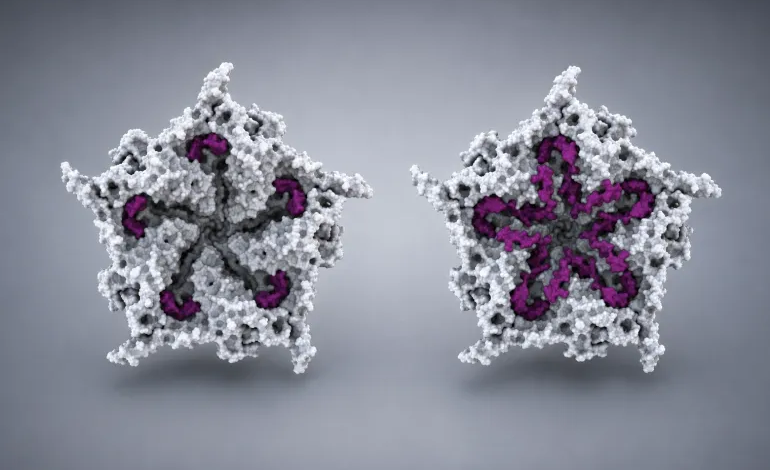
Researchers from Stanford University and the Arc Institute have used artificial intelligence to design complete genomes for new viruses capable of replicating and killing bacteria.
The achievement represents a significant step beyond using AI to design individual proteins or genes. Instead, the researchers demonstrated that AI can propose an entire genetic system containing the elements needed to function inside living cells.


The viruses created by the team, however, are not human viruses. They are bacteriophages, or phages, a class of viruses that specifically infect bacteria and do not attack human cells.


A New Generation of Bacteriophages
The researchers used two AI models known as Evo 1 and Evo 2. Their approach resembles the way large language models such as ChatGPT learn patterns, but instead of analyzing sequences of words, the models were trained to recognize patterns in DNA sequences.
The team selected a small bacteriophage known as ΦX174 as the starting point. This naturally occurring phage is known to infect Escherichia coli and contains only 11 genes in its genome.
According to the study published in the journal Science, the researchers trained the models on thousands of related genomes before asking them to generate new DNA sequences while preserving the genes and genetic elements necessary for producing a virus capable of replication.
Importantly, the AI did not directly construct the viruses. It generated proposed DNA sequences computationally, after which the researchers chemically synthesized those sequences and introduced them into bacterial cells in the laboratory.
The resulting viruses were therefore not created entirely from scratch. The AI learned from naturally occurring phage genomes and then generated new combinations of genetic patterns and variations.
Only a Small Number of Designs Worked
The researchers tested 285 AI-designed genomes, of which 16 successfully produced functional bacteriophages capable of replicating inside bacteria and slowing their growth or killing them.
The fact that most of the designs failed demonstrates that the technology remains at an early stage. Nevertheless, the successful results were significant because they showed that an AI model can propose complete viral genomes, some of which can actually function in living cells.
The experiments also showed that the newly created phages retained a high degree of specificity. Rather than infecting a broad range of bacteria, they generally targeted particular strains of E. coli, according to the study.
AI-Designed Phages Overcome Bacterial Resistance
One of the most notable aspects of the experiment involved bacterial resistance.
The researchers tested their newly designed phages against bacteria that had developed resistance to the original naturally occurring ΦX174 phage.
While the original phage was unable to infect those resistant bacteria, a mixture of AI-designed phages eventually overcame the resistance after several rounds of replication.
The finding suggests that AI could potentially become a tool for developing bacteriophages capable of targeting bacterial infections that have become resistant to conventional antibiotics.
In theory, researchers could generate large numbers of candidate designs and then identify those best suited to attacking a particular bacterial strain.
However, the experiment does not represent a ready-to-use medical treatment. The work was conducted in a laboratory using non-pathogenic bacterial strains, and substantial research would be required before any potential therapeutic application could be considered.
What Are the Potential Risks?
The researchers emphasized that they did not design viruses capable of infecting humans, animals or plants. The work focused exclusively on bacteriophages that target bacteria.
Nevertheless, the ability of AI systems to generate complete biological genomes raises broader questions about biosafety and the future governance of AI-assisted biological design.
The researchers called for biosafety experts to be involved from the earliest stages of genome-design projects and for safeguards to be established to prevent the technology from being misused to create harmful organisms.
The development therefore represents both a scientific milestone and a warning about the need for responsible oversight.
As AI moves from designing individual biological components toward generating increasingly complex genetic systems, researchers and policymakers face difficult questions: How should these technologies be regulated? What safeguards should govern access to them? And could increasingly capable biological AI systems eventually create new security risks?
For now, the Stanford and Arc Institute experiment remains a laboratory demonstration involving bacteriophages rather than human pathogens. But it highlights how quickly artificial intelligence is expanding its role in biological research—and why advances in this field are likely to make biosafety and governance increasingly important.