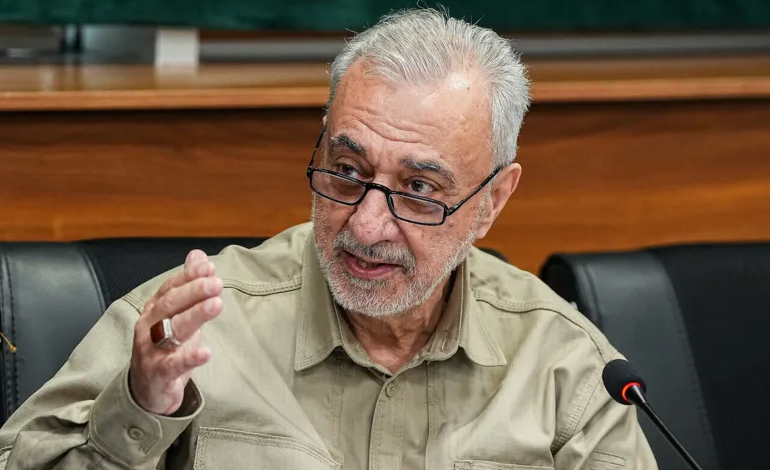
Mehrdad Akhlaghi Ketabchi is an Iranian military official whose career has been closely linked to the country’s missile and aerospace industries. After holding senior positions in Iran’s military manufacturing institutions, he became Minister of Defense and Armed Forces Logistics in President Masoud Pezeshkian’s government in October 2026, succeeding Aziz Nasirzadeh, who was killed in US-Israeli strikes in late February of the same year.
Ketabchi built his career around managing missile programs and defense industries, serving in several leadership roles within organizations affiliated with Iran’s Ministry of Defense. He has also been subject to international and US sanctions over his reported connections to Iran’s missile program and defense-related activities.
Early Life and Background
Mehrdad Akhlaghi Ketabchi was born on September 10, 1958, in Rasht, the capital of Gilan Province in northern Iran.
Education and Academic Qualifications
Ketabchi earned a bachelor’s degree in chemical engineering from Amirkabir University of Technology and a master’s degree in strategic management from Malek Ashtar University of Technology.
In a report assessing his qualifications for the defense minister position, Iran’s parliamentary Committee on National Security and Foreign Policy cited his academic credentials and stated that they had been approved by the Ministry of Science, Research and Technology.
Career in Iran’s Military Industries
Ketabchi previously headed the Shahid Bagheri Industrial Group, which is associated with Iran’s long-range missile programs. His responsibilities included managing the organization’s operations and securing equipment required for its activities, before he moved into broader leadership positions within the country’s defense industry.
In November 2014, then-Defense Minister Hossein Dehghan appointed him head of the Aerospace Industries Organization, an entity operating under Iran’s Ministry of Defense. He replaced Mehdi Farahi in the position.
At the time, Dehghan said Ketabchi had accumulated experience through a gradual career progression, advancing from lower-level positions to senior management roles within the organization and its affiliated industries.
Ketabchi later became head of the Defense Industries Organization, another institution under the Ministry of Defense. He remained in that position until his nomination for the cabinet post in October 2026.
International and US Sanctions
The United Nations Security Council added Ketabchi to its sanctions list in 2007 under Resolution 1747, citing his role in Iran’s missile program and his position as head of the Shahid Bagheri Industrial Group.
In July 2008, the US Department of the Treasury imposed sanctions on him, stating that he had acted on behalf of the industrial group and played a key role in its day-to-day management and negotiations to procure equipment.
In September 2020, the United States imposed further measures against him in his capacity as head of Iran’s Defense Industries Organization. The measures were linked to activities involving the supply, sale or transfer of conventional weapons to or from Iran.
Appointment as Iran’s Defense Minister
President Masoud Pezeshkian nominated Ketabchi for the position of Minister of Defense and Armed Forces Logistics on October 5, 2026. The nomination followed a period in which Majid Ibn al-Reza had been serving as acting minister after the death of Aziz Nasirzadeh.
Parliament received the nomination letter the following day. On October 18, 2026, lawmakers approved Ketabchi’s appointment by 237 votes to 15.
Defense Policy and Strategic Priorities
Ketabchi presented parliament with two policy programs for the defense sector: a six-month plan and a second program covering 22 months. Both outline priorities aimed at strengthening Iran’s military capabilities.
His agenda includes increasing missile production in response to regional and extra-regional threats, upgrading air defense systems and accelerating work on technologies for manufacturing heavy, multirole fighter aircraft.
The plans also call for broader cooperation with universities and private companies, particularly knowledge-based firms, alongside the development of unmanned aerial vehicles, cyber capabilities and electronic warfare technologies.
Another priority is rebuilding defense industrial facilities and ensuring that production can continue during crises and wartime. The program also includes measures to improve conditions for military personnel and retired members of the armed forces.