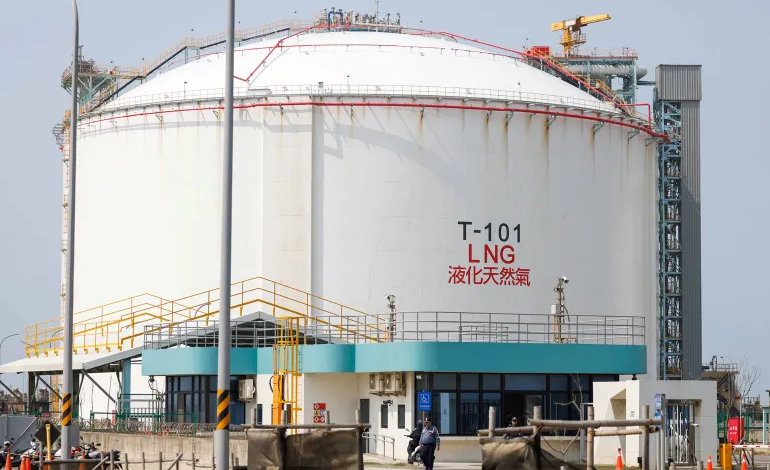
Taiwan has announced its readiness to invest up to $4.4 billion in a proposed natural gas pipeline project in the US state of Alaska, alongside a commitment to purchase 6 million metric tons of liquefied natural gas (LNG) annually. The move is aimed at strengthening energy security and diversifying the island’s supply sources.
In a statement issued on Wednesday, Taiwan’s Ministry of Economic Affairs said the expected cooperation would involve purchasing the specified volume of LNG once production begins, as well as participating in the project’s development through investments of up to $4.4 billion.


The ministry added that, if the project proceeds according to schedule, it is expected to begin contributing to Taiwan’s domestic natural gas supplies in 2032.
Strategic Project to Transport Gas to Asian Markets
US President Donald Trump previously announced during a visit to Wasilla, Alaska, that Taiwan had committed to purchasing 30% of the LNG expected to be transported through the future pipeline over the next 20 years, alongside an investment of $4.4 billion.
The pipeline project dates back several decades. It received support during Trump’s first presidential term and continued to attract attention under former President Joe Biden before Trump revived the initiative.
The proposed pipeline is expected to extend approximately 1,300 kilometers, transporting natural gas extracted from northern Alaska to the state’s southern region. There, the gas would be processed and converted into LNG before being shipped to Asian markets.
Taiwan Seeks to Diversify Its Energy Supplies
Taiwan relies heavily on imported energy and is seeking to strengthen the stability of its supplies while reducing the risks associated with dependence on a limited number of suppliers. These efforts have gained importance amid volatility in global gas markets following the war in the Middle East and disruptions linked to the Strait of Hormuz.
Official data showed that Australia was Taiwan’s largest LNG supplier during the first eight months of 2026, accounting for 34.8% of the island’s total imports.
In early 2025, Taiwan’s Ministry of Economic Affairs announced that state-owned energy company CPC Corporation would purchase LNG from Alaska while seeking opportunities to participate in exploration and production investments. The stated objective was to secure stable energy supplies for Taiwan in the future.
Taiwanese Premier Cho Jung-tai said on Wednesday that the government’s responsibility was to ensure the stability and resilience of the country’s entire energy supply system.
He added that authorities continued working to maintain reliable domestic supplies of oil, electricity and natural gas, noting that achieving this goal would require sustained efforts.
China Objects to Taiwan-US Energy Cooperation
China has criticized Taiwan’s efforts to strengthen its economic ties with the United States, arguing that commercial agreements should not be used to support the island’s independence.
Chinese Foreign Ministry spokesperson Mao Ning said attempts by Taiwan’s authorities to promote independence under the guise of economic and trade activities were doomed to fail.
Beijing considers Taiwan part of its territory and seeks reunification with the mainland, while refusing to rule out the use of force to achieve that objective.
Technical Challenges and Questions Over Economic Viability
Despite receiving support from the state of Alaska and US-based Glenfarne Group, the project faces technical challenges and questions about its substantial costs and economic viability.
The pipeline is not expected to become operational before 2030, while Taiwanese estimates suggest that its impact on domestic gas supplies may not begin until 2032.
The proposed agreement could strengthen energy ties between Taiwan and the United States. However, its implementation will depend on whether the parties can overcome financing and technical obstacles and complete the project within the planned timeframe.