Mauritania’s Prime Minister Continues Inspection of Public Service and Development Projects in Nouakchott

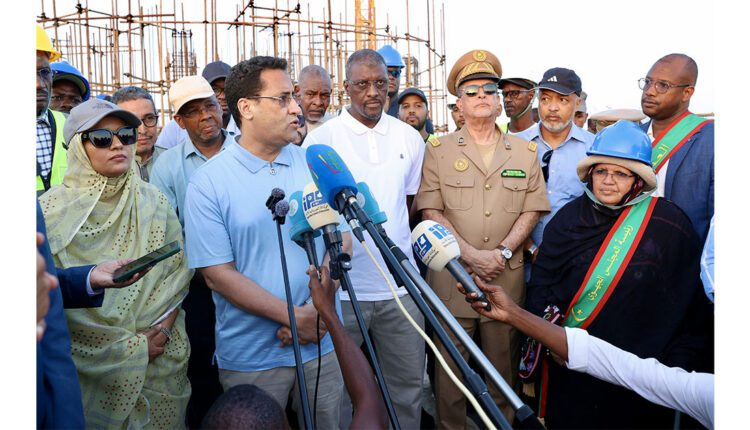
In accordance with the directives of President Mohamed Ould Cheikh El Ghazouani, Prime Minister Mokhtar Ould Djay conducted a field visit on Sunday for the second consecutive day to inspect a number of public service facilities and development projects in the capital, Nouakchott.
The visit aimed to assess construction progress and evaluate how the projects are expected to improve services for residents.
The prime minister visited the water station associated with the Idini expansion project in the Ksar district, the Northern Pole water station, and the “Pole A” wastewater project in the Teyarett district. The tour also included a model wastewater pipeline station in Tevragh Zeina.
In addition, Ould Djay inspected the rehabilitation projects for the “Tarhil” pond in Toujounine and the “Taazour” pond in Tevragh Zeina, as well as the Nouakchott landmark project known as the “Monument to the Nation.”
At each stop, the prime minister received technical briefings on the stages of implementation, operating procedures, construction progress, and expected completion dates. Officials also outlined the projects’ development objectives and their anticipated contribution to improving living conditions, particularly for residents of Nouakchott.
On-Site Assessment of Government Projects
Following the inspection tour, Ould Djay said he had completed the field visits that began on Saturday to assess progress on several development projects underway in Nouakchott. He said the visits were carried out in accordance with the president’s instructions to monitor implementation and evaluate the results on the ground.
The prime minister stressed that the presidential directives call for direct inspections of construction work and consultations with citizens’ representatives, local authorities, and residents whenever possible. The aim is to assess the efforts being made by public authorities and determine their impact on the quality of services provided to the population.
He explained that the first day of the tour covered projects overseen by the ministries responsible for health, youth empowerment, and housing and urban development. The second day focused on three major water and sanitation projects, along with three additional projects being implemented by the Nouakchott Regional Council.
Idini Project Aims to Address Nouakchott’s Water Challenges
Discussing the projects overseen by the Ministry of Water and Sanitation, Ould Djay said the tour began with an inspection of the Idini project, whose foundation stone was laid by President Mohamed Ould Cheikh El Ghazouani on December 3, 2024.
The project forms part of a broader strategy to establish a lasting and sustainable solution to water supply problems in Nouakchott.
The prime minister recalled the water crises that affected the capital during the autumn seasons of 2023 and 2024 and at the beginning of 2025, when authorities faced difficulties in ensuring an adequate supply of drinking water.
He said that, in response to the crisis, the president visited the Beni Naaji facility to assess the situation firsthand and determine the necessary measures. Three main decisions followed: finding an immediate solution to sediment and water turbidity, securing an additional water source—particularly during the autumn season—and developing a sustainable solution capable of meeting Nouakchott’s water needs over the next 10 to 15 years.
Technical Solutions to Improve Water Quality and Supply Reliability
Ould Djay said the government had worked to implement these decisions, adding that the turbidity problem had been resolved through a technical solution developed and implemented within seven months, in line with the contractual deadline and without delays.
He added that the facility has been operating at full capacity since it entered service, with no reported complaints or concerns related to the water problem.
According to the prime minister, these results demonstrate the effectiveness of the measures taken to address the crisis and strengthen the reliability of water supplies to the capital.