Vance: Ending the War with Iran Requires a Significant Reduction in Uranium Enrichment Capabilities

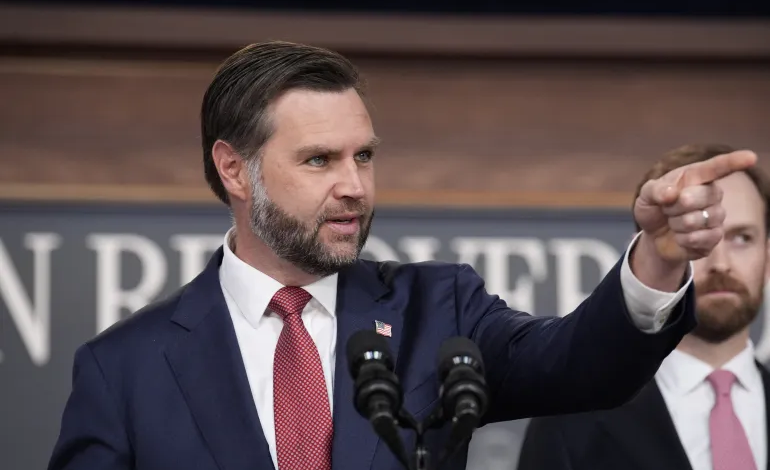
U.S. Vice President JD Vance said that reaching an agreement to end the ongoing war between the United States and Iran would require Tehran to make a significant and immediate reduction in its uranium enrichment capabilities, stressing that Washington would not be satisfied with promises concerning future measures.
In an interview, Vance said any potential agreement must include concrete steps by Iran to demonstrate that it has abandoned efforts to develop a nuclear weapon. He noted that continued production of uranium enriched to 60% raises questions about the nature of Iran’s nuclear program.
Vance added that guarantees or promises about future actions would not be sufficient for the United States, emphasizing that Tehran must take concrete steps regarding its current enrichment capabilities.
Stalled Negotiations Over the War and the Strait of Hormuz
Iran and the United States have exchanged proposals in recent weeks aimed at reaching an arrangement to end the war and allow the reopening of the Strait of Hormuz, one of the world’s most important maritime routes for transporting energy supplies.
However, U.S. President Donald Trump rejected Iran’s latest proposal and warned that military operations could escalate after the midterm congressional elections scheduled for November.
Vance confirmed that the U.S. administration remains open to reaching an agreement, but said Washington is demanding clear Iranian concessions on the nuclear issue. He stressed that the United States wants concrete actions rather than statements or commitments.
The negotiations come as the war has caused significant disruption to global energy markets, while its economic and political consequences have become an increasing burden for the Trump administration and the Republican Party ahead of the midterm elections.
Washington Questions Iran’s Decision-Making Structure
Vance said another factor complicating the negotiations is uncertainty over who ultimately holds decision-making power in Iran. He explained that U.S. officials are holding discussions with President Masoud Pezeshkian and Foreign Minister Abbas Araghchi.
However, he said Washington does not know precisely how much authority the two officials possess within Iran’s governing system, particularly following changes to the country’s power structure after U.S.-Israeli strikes killed Supreme Leader Ali Khamenei at the beginning of the war.
Vance said the United States had observed uncertainty surrounding the way decisions are made in Iran, describing it as an additional factor complicating the negotiating process.
Trump has also expressed a similar view, saying that one of the main problems facing his administration is uncertainty over who is actually running Iran.
Iranian Foreign Ministry spokesman Esmail Baghaei, however, rejected those statements, saying U.S. officials are well aware of their Iranian counterparts and understand how the country’s decision-making institutions operate.
Baghaei said the problem was not Washington’s inability to identify its negotiating counterparts, but rather what he described as contradictory positions and conflicting messages coming from U.S. officials.
The War Becomes an Election Issue in the United States
Vance said he had personally spoken with military commanders to assess developments on the battlefield, rejecting concerns about a severe shortage of U.S. ammunition.
He said Iranian forces remain capable of occasionally targeting commercial vessels in the Strait of Hormuz, but argued that they are largely unable to disrupt energy exports through the waterway.
The war costs the United States around $3 billion a month, making it one of the key issues in the election campaign, particularly as higher energy prices affect the cost of living for voters.
Trump and the Republicans are facing growing pressure in several competitive states, where the consequences of the war and rising prices could influence the outcome of the midterm elections and determine which party controls Congress.
During his campaign appearances, Vance has sought to defend Trump’s handling of the war, urging Republican voters not to allow the issue to affect their support for the party’s candidates in the upcoming elections.
In Alaska, Vance participated in a campaign rally supporting Republican Senator Dan Sullivan, who is facing a close reelection race against Democratic challenger Mary Peltola.
Although Trump won Alaska by 13 percentage points in the 2024 election, rising living costs have made the state’s political contest more competitive and less predictable.
Vance is also increasingly viewed as one of the leading figures within the Republican Party who could potentially seek to succeed Trump in the White House.