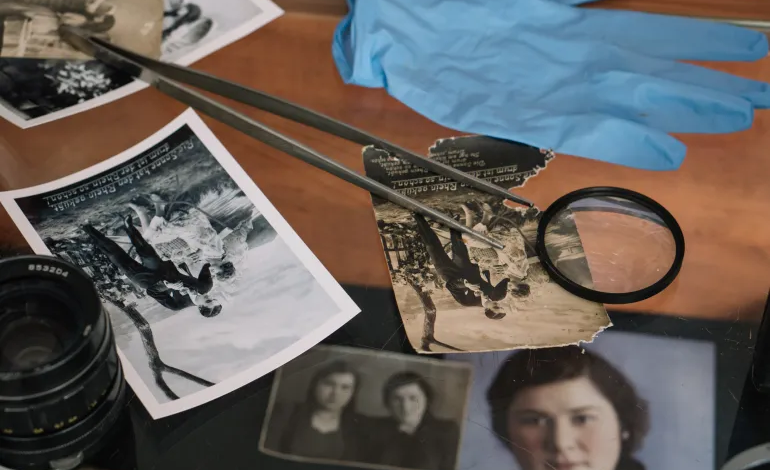
The enhancement and restoration of old photographs has become one of the most prominent applications of artificial intelligence in the creative and technical fields. Instead of relying on complex manual retouching processes that once required advanced expertise in tools such as Photoshop, it is now possible to reconstruct low-quality images, remove noise, and recover missing details within minutes using AI. Multiple technical reports indicate that this field is experiencing rapid growth due to advances in deep learning models and intelligent image upscaling techniques.
How does AI interpret old images?

Artificial intelligence enhances images using neural networks trained on millions of paired high-quality and low-quality photographs. The goal of these models is to learn the relationship between degraded images and their clear counterparts, enabling them to predict missing details when an old or damaged image is provided as input.
A key technique used in this process is known as Super Resolution, which relies on pattern recognition and contextual reconstruction of visual data.
What is Super Resolution?
Super Resolution is one of the core modern image enhancement technologies. It aims to increase image resolution while preserving or intelligently reconstructing details. Rather than simply enlarging an image, it attempts to infer missing information based on learned patterns from training data. It improves sharpness, reduces noise, and reconstructs visual details through generative and predictive modeling.
How image enhancement works in practice
The process of restoring old images typically involves several technical stages:
- Noise reduction (Denoising): Algorithms first remove digital noise or grain caused by poor cameras or image degradation over time.
- Color and lighting correction: The system analyzes lighting distribution and adjusts balance. In many cases, black-and-white images can also be colorized using deep learning models that predict realistic colors.
- Detail reconstruction: In this phase, AI attempts to recreate missing visual elements such as facial features or background structures.
Popular tools used in image enhancement
Remini
One of the most widely used applications in this field, Remini focuses on facial enhancement and reconstruction of old portraits using specialized AI models designed to restore facial details with high accuracy.
Adobe Photoshop and Adobe Firefly
Adobe integrates AI-powered tools within Photoshop, including object removal, image enhancement, and generative filling. These features are powered by Adobe Firefly, a generative AI system designed for creative image processing.
Topaz Photo AI
A professional-grade tool commonly used by photographers. It offers sharpening, deblurring, and high-quality image upscaling without significant loss of detail.
MyHeritage Photo Enhancer
This tool is widely used for restoring historical and family photographs. It applies facial analysis models to reconstruct and enhance old images with improved clarity.
Does AI truly restore the original image?
A critical technical point is that AI does not literally recover the original image. Instead, it generates a statistically informed reconstruction of missing details based on training data.
This means that while results can be highly accurate when sufficient information exists, some outputs may be approximate when the source image is severely degraded. For this reason, researchers caution against using AI-restored images in legal or historically sensitive contexts without additional verification.
Applications of AI-based photo enhancement
Historical archiving: Museums and libraries use AI tools to restore and digitize old photographs for future generations.
Media and journalism: Archival images are enhanced before digital publication.
E-commerce: Product images are improved to increase clarity and visual appeal, which can boost sales.
Personal use: Individuals restore family photographs or childhood images for preservation.
Limitations and challenges
Despite rapid advancements, AI-based image restoration still has limitations. It may generate inaccurate details, introduce non-existent elements, or alter the original character of historical images. Extremely degraded photos may result in outputs that resemble reinterpretations rather than true restorations.
Additionally, uploading images to cloud-based services raises privacy concerns. In cases of severe degradation, results may become more speculative than accurate reconstruction.
How non-experts can use AI to enhance photos
Modern AI systems allow users to improve images through simple text-based instructions. This process is now accessible through widely used AI assistants and tools such as Gemini, ChatGPT, and Copilot, though results vary depending on the platform.
The basic approach involves clearly describing the desired improvement, such as noise reduction, resolution enhancement, facial reconstruction, or colorization.
For example, a user might input prompts such as:
“Enhance this old photo by removing noise, reconstructing facial details in high resolution, and improving lighting while preserving original identity and expressions.”
“Convert this old image into ultra-HD quality, remove blur and scratches, and enhance details while keeping faces unchanged.”
For colorization:
“Convert this black-and-white photo into a realistic color version while preserving historical accuracy and original facial features.”
For low-resolution images:
“Upscale this image to 4K resolution, enhance sharpness, and reconstruct missing edges naturally without altering identity.”
For blurry images:
“Reduce blur and restore focus while reconstructing facial and background details realistically.”
For damaged photos:
“Repair scratches and visual defects, restore clarity, and preserve all original facial characteristics without modification.”
A key principle across all cases is to preserve identity and avoid altering core facial structure, ensuring that the output remains a clearer version of the original rather than a redesigned image.
These methods work because modern AI models translate textual instructions into complex visual transformations, using learned representations to enhance and reconstruct images in a context-aware manner.