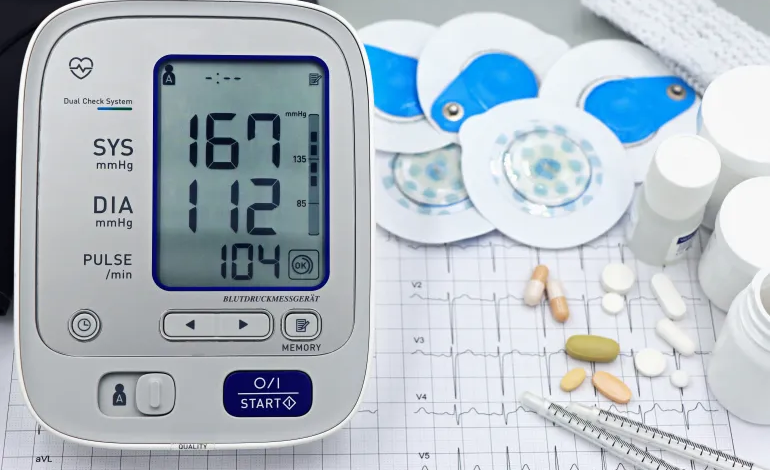
A high blood pressure reading can be worrying, particularly for someone who has never been diagnosed with hypertension. However, a number recorded by a blood pressure monitor at a specific moment does not necessarily reflect a person’s usual blood pressure. Blood pressure naturally fluctuates throughout the day and can be affected by temporary factors such as stress, physical activity, caffeine, pain, lack of sleep, and even the way the measurement is taken.
For this reason, hypertension is generally not diagnosed based on a single reading. Instead, repeated measurements taken correctly are needed to distinguish a temporary rise from persistent high blood pressure.


Why Does Blood Pressure Change?
Family medicine consultant Dr. Fatima Al-Zahra Noureddine explains that hypertension is not usually diagnosed from a single measurement because blood pressure can vary from one moment to another due to stress, physical exertion, coffee, certain foods, insufficient sleep, and pain.
The 2024 European Society of Cardiology guidelines emphasize that a blood pressure measurement taken during a single clinical visit is generally insufficient to confirm a diagnosis, particularly when the reading is close to the diagnostic threshold. The guidelines therefore favor confirming the result through out-of-office measurements or repeating the measurement during a later visit when out-of-office monitoring is not possible.
Under the European guidelines, hypertension in a clinical setting is defined as a reading of 140/90 mmHg or higher. For home monitoring, the threshold is an average of 135/85 mmHg or higher, while the threshold for 24-hour ambulatory monitoring is an average of 130/80 mmHg or higher.
Simple Measurement Errors Can Affect the Result
When measuring blood pressure at home, Dr. Fatima recommends avoiding measurements immediately after exercising, drinking coffee, or smoking. The person should sit quietly for five minutes before taking the measurement.
During the measurement, it is important not to talk or move. The back should be supported, both feet should remain flat on the floor, and the arm should be supported at heart level. The cuff should also be placed directly on the skin and should be the appropriate size for the arm.
The American Heart Association recommends avoiding smoking, caffeinated beverages, and exercise for at least 30 minutes before measuring blood pressure. It also advises emptying the bladder and sitting quietly for five minutes beforehand.
Seemingly minor mistakes, such as talking during the measurement, failing to support the arm, or using an incorrectly sized cuff, can affect the result and make it less representative of the person’s actual blood pressure.
How and When Should Blood Pressure Be Rechecked?
Dr. Fatima recommends taking two readings during each session, with a gap of about one to two minutes between them, and recording the results. Measurements can be taken in the morning and evening for several days to obtain a more reliable average.
This approach is consistent with European guidelines, which recommend taking two measurements per session, one to two minutes apart, in the morning and evening for at least three days, and preferably up to seven days, before calculating the average.
The importance of confirming a diagnosis is also supported by a systematic review published in JAMA in 2021, which analyzed 52 studies involving more than 215,000 people. The review found that relying solely on blood pressure measurements taken in clinical settings has limitations that can lead to some people being incorrectly classified.
Home monitoring or ambulatory blood pressure monitoring can therefore provide a more accurate picture of a person’s usual blood pressure and help confirm whether hypertension is actually present.
White-Coat Hypertension and Masked Hypertension
One condition that demonstrates the importance of measuring blood pressure outside the doctor’s office is known as white-coat hypertension. In this situation, blood pressure is elevated in a clinical setting but remains normal at home.
A doctor may therefore recommend home monitoring or a 24-hour ambulatory blood pressure monitor to determine the person’s blood pressure under normal daily conditions.
The opposite condition is known as masked hypertension. Here, blood pressure may remain below the diagnostic threshold in the doctor’s office but rise above it at home or during ambulatory monitoring.
Out-of-office measurements can help identify both conditions and provide a clearer picture of how blood pressure behaves throughout the day.
When Should You See a Doctor?
Dr. Fatima recommends consulting a doctor when elevated readings occur repeatedly. Medical evaluation is also advisable if concerning symptoms such as severe headache, dizziness, blurred vision, chest pain, or shortness of breath occur.
These symptoms do not necessarily mean that high blood pressure is the cause, but when they occur alongside elevated readings, they warrant appropriate medical assessment.
At the same time, the absence of symptoms does not mean that blood pressure is normal. Hypertension often causes no obvious symptoms, which is why regular blood pressure measurement remains the primary way to detect it.
When Does High Blood Pressure Become an Emergency?
If a blood pressure reading reaches 180/120 mmHg or higher, the American Heart Association recommends waiting at least one minute and then taking another measurement.
If the reading remains at or above that level and is accompanied by chest pain, shortness of breath, sudden numbness or weakness, vision changes, or difficulty speaking, the situation may constitute a medical emergency and requires immediate medical attention.
If the reading remains at 180/120 mmHg or higher without new or concerning symptoms, the person should contact a healthcare professional promptly for further assessment and guidance.
Ultimately, one high blood pressure reading does not automatically mean that a person has hypertension. However, repeated elevated readings should be taken seriously. Recording measurements correctly and discussing them with a doctor can help determine whether the rise is temporary or whether it requires ongoing monitoring or treatment.